

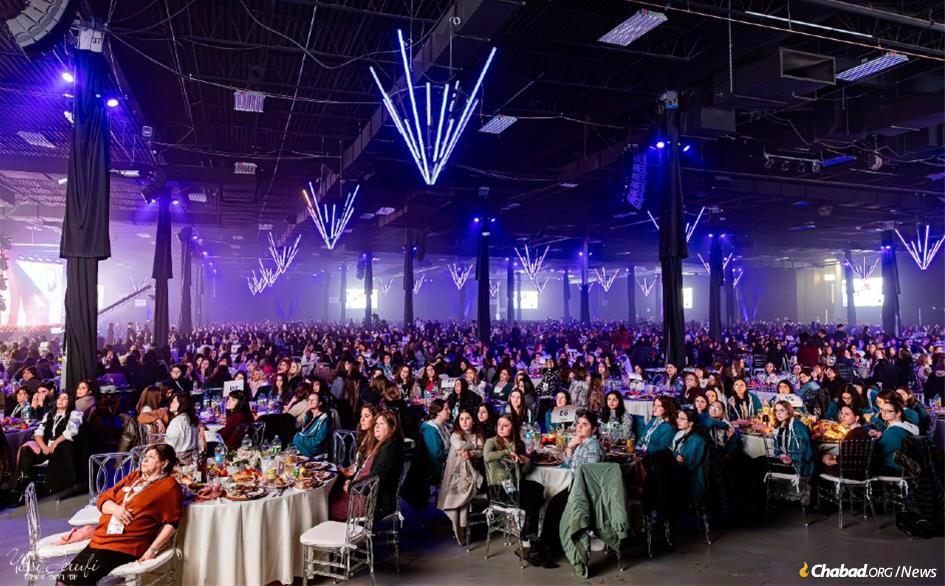
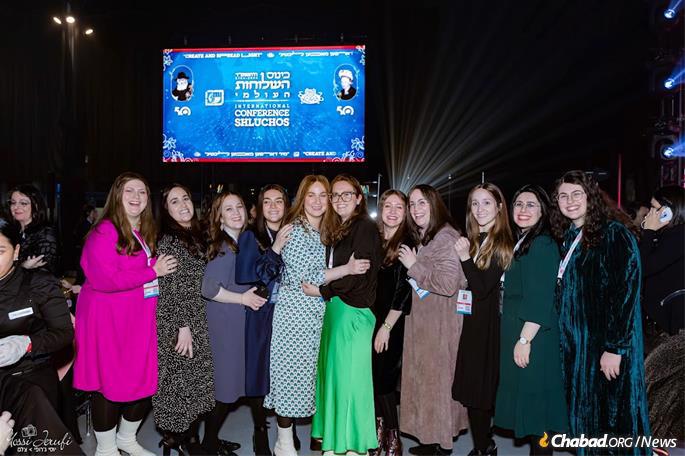
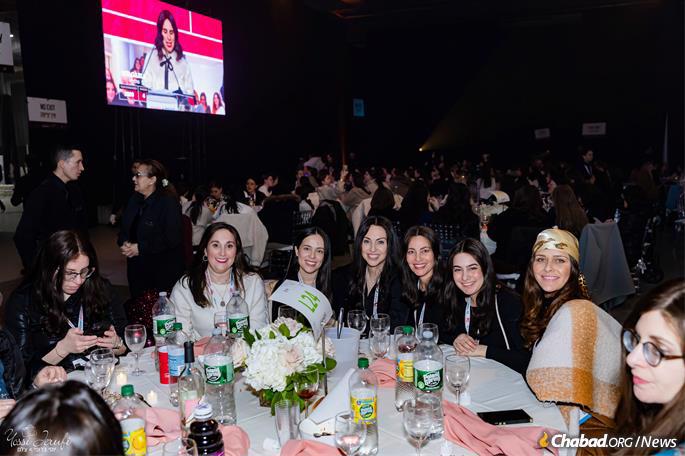
EDISON, N.J.—The energy in the massive convention-space-turned-banquet hall was palpable, as 4,000 Jewish women leaders from around the world gathered at the gala event of the annual International Conference of Chabad Lubavitch Women Emissaries (Kinus Hashluchos). The unique event, which has taken place every year since 1991, brings together the women behind the worldwide network of Chabad emissaries, from China to the Caribbean, and from the plains of Illinois to Israel.
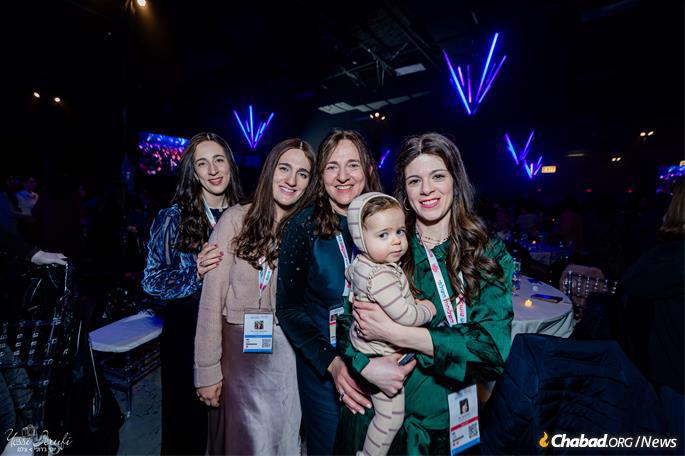
“Every year I come back and see more and more women that I’ve met at the Kinus, you meet old friends and new ones,” said Devorah Wilhelm, co-director, with her husband Rabbi Moshe Wilhelm, of Chabad of Oregon since 1983.
Wilhelm attended the first conference back in 1991, when the concept was new and unique. The gathering was timed to take place around the anniversary of the passing of Rebbetzin Chaya Mushka, wife of the Rebbe, Rabbi Menachem M. Schneerson, of righteous memory. Some might have wondered: Was it an imitation of the men’s gathering, which is held earlier in the year? Whatever questions anyone might have had were answered that first memorable weekend, when it became known that the Rebbe would be speaking to the women’s gathering that Sunday. “The atmosphere was electrifying, it was incredible,” Wilhelm recalled. “It was the ultimate validation we could get. Was our work important? The Rebbe made it clear it was.”

As Wilhelm spoke amid the lights and tables dotting the hall, an old friend, Chavi Epstein, stopped to chat. Epstein, co-director of Chabad of South Carolina with her husband, Rabbi Hesh Epstein, since 1987, missed the first Kinus Hashluchos because she’d had a baby a few weeks earlier. She was there the next year, however, in 1992, when the Rebbe once again delivered a special talk to the women. More than three decades later, Epstein can still quote verbatim the very deep and esoteric talk the Rebbe had delivered.
“The Rebbe charged us with the work of revealing the G‑dliness inherent in the physical, material world,” Epstein said. “This is the generation in which this special feminine strength would lead the way, the spirit and power of Shabbat. That’s what you feel in this room right now.”
Chany Scheiner, who is an emissary in Boulder, Colo., has also been coming to the Kinus for years. “It’s amazing to connect to my global community, my friends who I started out with and to see them and get hugs and encouragement.”
While she always gains something from the Kinus and being among fellow emissaries, or shluchot, Scheiner said in recent years women have started being more “real.” They are being much more open about both their successes and the things that didn’t work as well as they might have hoped, said Scheiner, adding “getting more real has been very positive.”
“When you connect with the other [shluchot], you realize you are not alone. You can gain so much from a workshop or meeting old friends,” said Chaya Uzan, the Chabad emissary to Abuja, Nigeria, with her husband, Israel.
She added that being at the Kinus “gives us the tools to continue our holy work and bring it into our communities, who also need the energy and inspiration we bring back home.”
Also having the best time were a group of several dozen teen girls from Israel, who took every opportunity they had to dance and sing, while a group of slightly older teens from Argentina soaked in the entire weekend.
“I think the girls get a new perspective when they come here,” said Yael Lloroff, a group leader from Chabad’s Machon Neshama program for post-high school girls in Buenos Aires. “They see we are all together. It doesn’t matter if you are more religious or less, if you are Sephardi or Ashkenazi. We are all b’yachad, together.”
The Gift
Each year, the Kinus Hashluchos brings together the women leaders of Chabad for five days of workshops and study sessions in the Crown Heights section of Brooklyn, N.Y. On Thursday, the 22nd of the Jewish month of Shevat—the anniversary of Rebbetzin Chaya Mushka’s passing—the women joined together in Queens to pray at the Rebbe’s resting place, known as the Ohel, as well as the Rebbetzin’s resting place nearby.
After a Shabbat spent in Crown Heights, the women converged on the massive convention hall in New Jersey for the conference’s concluding gala banquet. The formal program started off with Psalms recited for the health and success, both material and spiritual, of the Chabad women leaders, their families and communities around the world. Special Psalms for the safety and security of the inhabitants of the Land of Israel were read live from the Western Wall in Jerusalem by Irit Tzipori, Chabad emissary in the northern border community of Kiryat Shemona since 1987.
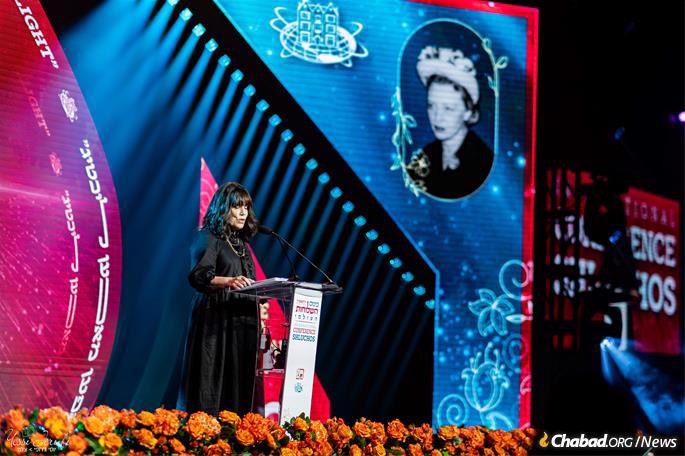
This year marks 50 years since the Rebbe launched the Shabbat candle lighting campaign, one of the mitzvahs given especially to women. The circumstances back then were reminiscent of today’s: Israel had suffered a devastating blow on Yom Kippur of 1973, when surrounding Arab armies launched an attack on the land and threatened to push the Jews into the sea. In the aftermath of the attack, the Rebbe called on all Jewish women and girls to fill the world with more light by lighting Shabbat candles each Friday before sundown.
Esther Sternberg, director of the Shabbat Candle Campaign, described the level of care the Rebbe had for this special, women-led campaign. Less than a week after his wife’s passing, the Rebbe met with Sternberg and handed her a white envelope that included a monetary contribution to the new fund the Shabbat Candle Campaign had established in memory of the Rebbetzin. “The fortunes [mazal in the original]” of all those engaged in sharing the light of the Shabbat candles with their fellow women and girls, the Rebbe told her, “will be brightened.”
“That is my gift to all of you,” Sternberg said. “This special blessing that the Rebbe gave is for every one of you.”
The women joined together in heartfelt songs, including Ani Maamin (“I Believe”), the Holocaust-era tune that expresses the Jewish People’s unwavering faith in the arrival of Moshiach. As they sang together in the darkened hall, some of the women waved electric tealights in the air and while others wrapped arms around each others’ shoulders and swayed.
The women then warmly welcomed Rabbi Moshe Kotlarsky, the vice chairman of Merkos L’Inyonei Chinuch and chairman of the International Conference of Emissaries, wishing him many years of health and success helping Chabad emissaries around the world. Kotlarsky announced new grants to ensure another 50,000 children could attend Chabad Hebrew schools, a slew of new programs, as well as a new advanced Chassidut learning institute geared specifically for the Chabad women leaders.
Talia Voskoboynik spoke of growing up in a secular Jewish family in California and accidentally joining a CTeen—Chabad teen program—event at Chabad of Camarillo, which led to her joining the annual CTeen Shabbaton in New York. Inspired, she headed to CTeen’s leadership retreat where she met Manya Lazaroff, co-director of Chabad at Texas A&M. She was so taken by Lazaroff that she chose to enroll at Texas A&M, where she spent four years growing closer to the Chabad emissaries and her Jewish faith. Soon, she began keeping Shabbat, then kosher—before long her mother joined her as well. Now married to Rabbi Lev Voskoboynik, the couple recently joined the team of Chabad emissaries at the University of Kansas.
She was followed by Michal Oshman, a former executive at eBay, Facebook and Tik Tok, who shared her journey to Chassidut. Growing up in a secular Israeli home, she’d early on been taught that life begins and ends in the corporeal realm. When, with the help of Chabad emissary Dr. Kate Loewenthal, she discovered the depths of Chabad Chassidut, she was hooked.
Oshman said she was 38 years old and her daughter, just 8, when she lit Shabbat candles for the first time. “The tears came out of my eyes, and the rest is history,” she said
Calling Chabad the “most successful global organization,” she said that the Rebbe empowered women to be able to build homes and families, and lead on a global level. “The Rebbe invented global!” she exclaimed.
Chani Klein, co-director of Chabad of Eilat, told the crowd of the travails of the 70,000 refugees from the “Gaza envelope” who arrived in her southern tourist hometown in the aftermath of the Palestinian’s mass terror attack on Oct. 7. Traumatized and alone, the refugee families needed help. So she started a preschool, then a teen club, then programs for whole families—now running in 45 separate hotels housing the families.
Many of them, she said, came from secular backgrounds and had never engaged with their Jewish heritage. Something had clearly changed, however. Learning the words of Shema, Judaism’s foundational prayer, lighting Shabbat candles, studying Torah, the men, women and children were grabbing hold of their faith in this darkest of times.
Now they’re slowly going back. “Instead of going back as individuals,” she observed, “they’re going back as a nation.”
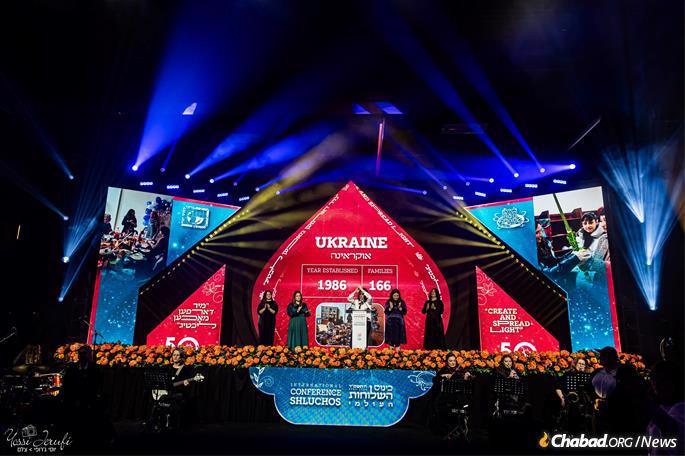
The evening was wrapped up with a high-energy roll call of the women from all 50 U.S. states and 100-plus countries where Chabad has a permanent presence to rise and be recognized.
With Wyoming done and mentioned, the announcer, Mushka Raskin of Chabad of Jamaica, called out: “A round of applause for the whole world!”



Start a Discussion