


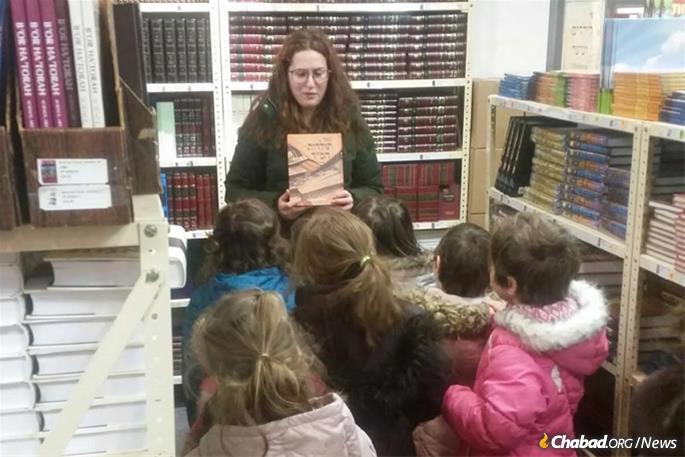
With more than 2,000 volumes in its vast catalogue, Kehot Publication Society is the world’s leading publisher of Jewish books. Yet nearly 20 percent of their annual sales takes place during a single week in December or early January. That’s when the publisher’s showroom bookstore in Brooklyn, N.Y., fills to capacity. Adults can be seen dragging shopping baskets laden with books—tomes of Jewish law, Chassidic philosophy and history, rabbinical treatises—from aisle to aisle, while children buckle under the collective weight of their brightly colored picture books.
During this week the store, which has stood at the corner of Eastern Parkway and Kingston Avenue in Crown Heights since the early 1980s, officially remains open from morning until midnight. In reality, it’s later than that.
“We’re there until the last customer leaves,” says Mendel Laine, Kehot’s managing editor. “It’s not unusual for that to be 3 a.m.”
Welcome to Hei Tevet, the fifth day of the Hebrew month of Tevet, the Jewish festival of the books, corresponding this year to Dec. 17. Since 1987, this day has been marked around the world with an emphasis on a trait particular to the People of the Book—buying more of them, specifically Jewish ones. More than two decades ago, Kehot introduced a 50-percent-off promotion on Hei Tevet, but demand has grown so high in recent years that the sale was extended to a full week.
Now, throughout the week, checkout lines snake through the store and past display stands. To help cope with the crush, Kehot hires additional staff for both their store and warehouse. At the same time, orders flood their website—where the sale is also available—from places that are home to large Jewish communities to the most remote parts of the world. To cope with the online demand, Kehot increases its bandwidth to ensure the site doesn’t crash.
Kehot, founded in 1941 by the Sixth Rebbe—Rabbi Yosef Yitzchak Schneersohn, of righteous memory—shortly after arriving in the United States from Nazi-occupied Europe is the central publishing house of the Chabad-Lubavitch movement. Its staff and scholars maintain the task and responsibility of editing and publishing new works on Jewish thought, knowledge and practice; preserving, annotating and reissuing previously published ones; and making available as much of its massive library of prints at one time as humanly possible. Since its founding it has disseminated more than 100,000,000 volumes in Hebrew, Yiddish, English, Russian, Spanish, French, Italian, Portuguese, Dutch, German, Farsi and Arabic.
But during this season of the books, Kehot is not the only one making more Jewish books available for purchase. Publishing houses, including Chabad.org’s own growing number of print publications, as well as independent Judaica stores, carry their own promotions during this time.

The Holiday’s Painful Origins
Hei Tevet marks the day in 1987 when the U.S. District Court for the Eastern District of New York ruled decisively that the vast and rare library collected by the Sixth Rebbe and spirited out of the Old World belonged—as the Rebbe himself did—to the Chabad movement as a whole.
For millennia, Jewish wisdom, thought and practice had been passed down from generation to generation via the written word. When printing presses came into existence, Jewish works were among the first to be printed, making Jewish books more than just items but links in the transmission of tradition stretching back to Sinai. And what better way to mark this holy library’s return to its rightful place than for each and every individual upgrading and expanding their own home library?
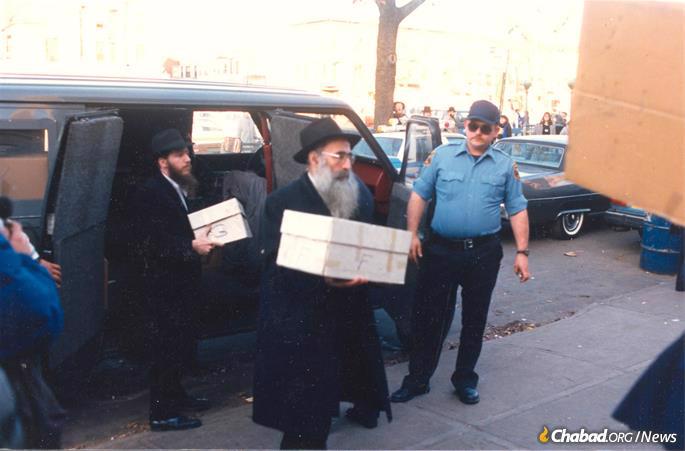
The holiday’s origins are painful. In the winter of 1985, the Sixth Rebbe’s estranged grandson began surreptitiously removing hundreds of rare volumes from the library’s home in the central Chabad synagogue at 770 Eastern Parkway in the Crown Heights neighborhood of Brooklyn. When confronted, he claimed that the books were his own private property, rightfully inherited from his grandfather. By the time his actions were discovered, he had already sold a number of them on the rare Judaica market, garnering a six-digit gain; the rare-book dealers in turn sold them for even higher figures. An emergency court injunction was placed to put a halt to this activity. The case had then gone to federal court.
Throughout this period the Rebbe, Rabbi Menachem M. Schneerson, of righteous memory—the Sixth Rebbe’s son-in-law and successor—spent hours speaking about the spiritual challenge to the Chabad movement’s activities and international growth that the ownership claims over the books truly represented.

“As the saga unfolded,” writes Asher Deren in a long essay delving into the story’s events and significance, “it became apparent to the community at large that the issue was not merely a challenge to ownership of the library, but pivoted on such essential matters as the very definition of Jewish leadership, from the times of Moses to the Rebbe today.
“These existential and interconnected questions, whose answers flow from Judaism’s historical roots in the Divine Revelation narrative of Torah’s transmission from Sinai onward, fittingly revolved around the ownership of holy books.”
Rabbi Yosef Yitzchak’s vast library, containing both valuable books and the priceless ksovim—the writings of the Chabad Rebbes dating back to the founding of the movement conveyed from generation to generation—was a physical and spiritual manifestation of the chain of tradition. Rabbi Yosef Yitzchak had refused to leave the Soviet Union without it, and it had miraculously survived fire and hell. A suitcase of the most irreplaceable writings came with him on his 1929 trip to the land of Israel and the United States, and was with him through the Nazi bombing of Warsaw in 1939. If it was merely personal property, as was being claimed, it meant the chain had ended with him. The self-sacrifice, the mission, the calling ... it had all come to an end.
The Rebbe took these charges very seriously. Once the trial was underway, he traveled to pray at his father-in-law’s gravesite, the Ohel in Queens, five days a week as opposed to the twice-a-month visits that had been his custom until then. As the Rebbe did not eat until he returned from the Ohel, this meant he was fasting for most of each week.
Agudas Chasidei Chabad, the umbrella organization for the Chabad-Lubavitch movement, retained prominent attorneys Nathan Lewin of Washington, D.C., and Jerome Shestack of Philadelphia, and among expert witnesses to testify on the plaintiff’s behalf were the late Elie Wiesel and Professor Louis Jacobs. The Rebbe instructed the lawyers to follow the path they felt most appropriate, but did point to a letter written by his predecessor to Alexander Marx, the librarian of Jewish Theological Seminary in New York—in which the Sixth Rebbe had clearly articulated that his library was not a mere personal possession but a library containing works of infinite value to the Jewish people at large and belonging to the movement he led—as a key piece of evidence. Indeed, it would prove invaluable.
“Defendants seek to explain this letter as duplicitous and of a piece with the wartime letters in German intended to be read by the Nazi censor. For reasons to be discussed more at length hereinafter, the explanation must be rejected ... ,” wrote Judge Charles Sifton in his decision. “Not only does the letter, even in translation, ring with feeling and sincerity, it does not make much sense that a man of the character of the Sixth Rebbe would, in the circumstances, mean something different than what he says ... .”
The other turning point was the testimony of the Rebbe’s wife, Rebbetzin Chaya Mushka, the Sixth Rebbe’s second daughter.
“The books belonged to the Chassidim,” she said simply, but intensely, in her deposition, a tape of which was played in the courtroom, “because my father belonged to the Chassidim.”
Following a 23-day trial (Agudas Chasidei Chabad of United States v. Gourary, E.D.N.Y. 1987), the court handed down its ruling on the 5th of Tevet, corresponding to Jan. 6, 1987. “The conclusion is inescapable that the library was not held by the Sixth Rebbe at his death as his personal property,” wrote Sifton in his ruling, “but had been delivered to plaintiff [Agudas Chasidei Chabad] to be held in trust for the benefit of the religious community of Chabad Chasidism.”

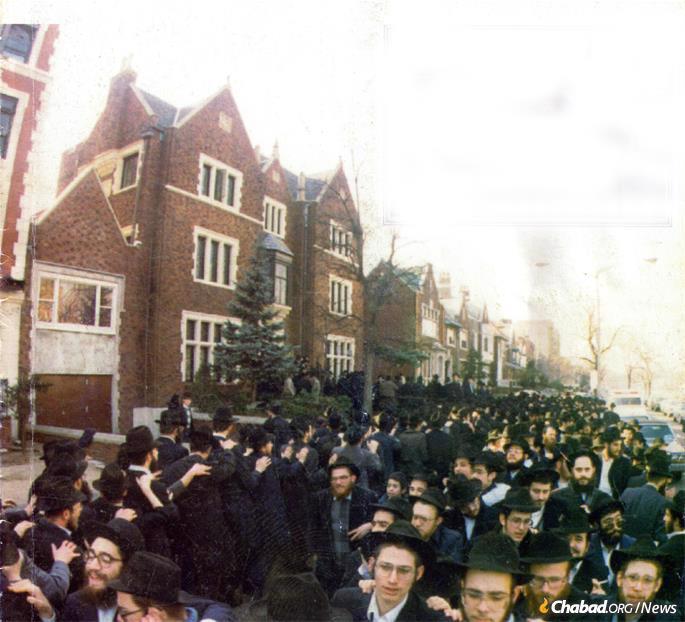
Within minutes of the news, celebration broke out in Brooklyn, rapidly spreading to Jewish communities around the world. In the central Chabad synagogue at 770 Eastern Parkway in Crown Heights, the singing and dancing lasted for seven days straight.
The Rebbe acknowledged this outpouring of joy, giving a talk each day of the festivities. But after a week the Rebbe told the growing crowds that it was time to celebrate the victory in a deeper, more concrete way: By redoubling their work, with a specific emphasis on the added study of Torah.
The Emphasis on Buying Books
When the first anniversary of the victory came about the next year, the Rebbe underlined that it was not enough that the Jewish community had regained possession of its rare collection of books, they must be studied. In his talk that Shabbat afternoon, he suggested that to mark 500 years since the birth of Rabbi Yosef Caro, the compiler of the Code of Jewish Law (Shulchan Aruch), Jewish booksellers and stores ought to make a special sale so that more people could purchase the volumes.
He also spoke about the importance of Jewish households containing at the very least the foundational texts of Jewish life: A Chumash (Five Books of Moses), prayer book, Psalms, Tanya and books pertaining to the practical observance of Jewish life. This should be so for newlyweds as well, young men and women just beginning the work of building a household, as well as children, who could in this day and age of readily available books begin building their own Jewish libraries at a young age.
“According to worldly conventions,” he said, “the victory of an expensive object, like precious stones and diamonds, is celebrated by giving it more respect: guarding it in the most dignified place, so that no-one will touch it, and surely not to use it. ... But according to Torah the victory of holy books ... is by using them and learning from them even more—the more they are used, the more dignity they have, even if they become worn out and torn from use.”
A little more than a decade earlier, the Rebbe had introduced as one of his mitzvah campaigns one known as Bayis Malei Seforim, or “Home Filled With Jewish Books.” Now he began expanding on the idea.

“This day is connected with seforim [Jewish books],” the Rebbe explained on Hei Tevet a year later, in 1989, “and so it is apropos that we discuss the vital importance of Jewish books.”
Men, women and children, he asserted, ought to utilize the special day of the books to purchase new Jewish books, repair old ones, or assist and enable fellow Jews to buy or repair Jewish books. To spur this on the Rebbe personally participated, standing in the synagogue at 770 distributing two $1 bills to each individual: one for charity, the second for the express purpose that they use them to buy or repair Jewish books.
“That’s when the crowds started filling the store,” says Rabbi Yosef B. Friedman, director of Kehot. “The Rebbe said that buying books was the way to mark the victory, so we got swarmed.”
Hei Tevet comes on the heels of Chanukah, and so he recalls children of the youngest age coming into the store and fishing through their pockets for the Chanukah gelt they had received from their parents or grandparents to buy new books. Then neighborhood schools began bringing class by class to the store.
“Now we stretch the sale out over a week because there’s no way we could handle the demand otherwise,” says Friedman. The schools, in New York and around the world, also coordinate with publishers, Kehot among them, to arrange book fairs at school.

Kehot’s mission to make even the most esoteric elements of Torah thought available to the world means that it prints works that are both wildly popular and those that are more scholarly. The standard Chabad prayer book, compiled and edited by Rabbi Schneur Zalman of Liadi and today published in, among other forms, the popular blue Hebrew-English prayer book seen in synagogues around the world, is a perennial blockbuster item (available in seven languages). Rabbi Schneur Zalman also wrote a longer version with lengthy Kabbalistic explanations, which, on the other hand, is a much more difficult work for most. Re-typesetting and annotating the Kabbalistic prayer book cost to the tune of $200,000, and to even hope to recoup costs would have required Kehot to price the two-volume set at a prohibitive $150. Instead, with the help of generous donors, it sells for $35.97 at the sale price.
Among the yearly best-sellers, says Laine, are basic works such as My Prayer, Lessons in Tanya, The Lubavitcher Rabbi’s Memoirs, and the multi-volume Chassidic Heritage Series, a collection of bilingual renderings of classic works of Chassidus.
At times, the item in demand can be surprising. This year, the ninth volume of Sefer Ha’Arachim, the scholarly encyclopedia of Chassidic concepts that a small team of scholars have been at work on for decades, is being released, and Laine predicts that it will be quickly snapped up.
The theme and call of Hei Tevet, both during the ordeal and in the aftermath of the spectacular victory, were Didan Notzach, which literally translates as “We are victorious,” or “Victory is ours.” The phrase, which originates from a relatively obscure Midrash [Vayikra Rabbah 24:3] and which the Rebbe had spoken about at great length, was printed on bumper stickers and signs, and put to song more than once. But there was only one way, the Rebbe explained in 1988, to see if the victory was real.
“The concrete lesson from everything we have discussed until now ... ,” he said in Yiddish, “is that from this point forward Torah study must grow and be strengthened. ... This will be the ‘true test’ of whether the books were truly victorious, Didan (d’Haseforim) Notzach, ‘The victory (of the books) is ours.’ ”
With thanks to “A Chassidishe Derher” magazine and Rabbi Avraham Vaisfiche of Kehot Publication Society.
To take advantage of the Hei Tevet annual sale, visit the Kehot online store here.





Join the Discussion