


Ezekiel (Yechezkel, יְחֶזְקֵא-ל) was a prophet who lived in Babylonia at the time of the destruction of the First Temple. Among his more famous prophecies, which were compiled in the Book of Ezekiel, are his visions of the Divine Chariot, the Valley of the Dry Bones and the Third Temple.
Life of Ezekiel
Ezekiel was born in the Land of Israel to his father Buzi, a priest,1 and it was there that he began his career as a prophet.2 Then, in the year 3327 (434 BCE), Jerusalem was conquered by Nebuchadnezzar, king of Babylonia. Nebuchadnezzar exiled the Jewish king Jehoiachin (Jeconiah) along with ten thousand captives, including the king’s family, the nobility of the land and the leaders of the army.3 Among the captives was the prophet Ezekiel.4
Ezekiel spent the rest of his life in Babylonia, where he envisioned most of his prophecies. Ezekiel’s prophecies are unique in that they were experienced in Babylonia, although as a rule the Divine spirit does not rest in the Diaspora. Nevertheless, since Ezekiel had already begun to prophesy in the Land of Israel, he continued to do so after leaving it.5
Perhaps since he did not dwell in the Land of Israel, Ezekiel did not commit his prophecies to writing. Instead, the Men of the Great Assembly—a group of 120 Jewish prophets and sages who lived c. 3400 (360 BCE)—accepted the task of compiling the Book of Ezekiel.6
Read more: The Men of the Great Assembly
The Divine Chariot
The book of Ezekiel begins with his famous prophecy of the Divine Chariot. In this vision,7 which he saw in the year 3332 (429 BCE) while standing on the banks of the Chebar River,8 Ezekiel describes in vivid detail G‑d’s supernal throne, supported by four angel-like creatures with four distinct faces: that of a human, a lion, an ox and an eagle.9
This chapter of Ezekiel serves as the foundation for much of Kabbalistic literature. In fact, the esoteric body of Torah as a whole is referred to in the Talmud as Maaseh Merkavah—“the making of the Divine Chariot.”10
This portion is read as the haftarah on the first day of Shavuot. Shavuot commemorates the giving of the Torah on Mt. Sinai, when G‑d revealed Himself accompanied by multitudes of angels—a theme related to Ezekiel’s vision.11
Read more: What Happened at Matan Torah

Ezekiel’s Style: Word Pictures and Technical Descriptions
“You are to them like a song on the flute, which has a beautiful voice and plays well,” G‑d tells Ezekiel.12 Ironically, Ezekiel is one of the few prophets whose book is largely written in prose. Yet his prophecies include some of the most soul-stirring word pictures of G‑d’s relationship with His people, the importance of each of its individuals to Him, and of the eternality of their mission.
In one of these, he begins by picturing the Jewish people as an infant abandoned, uncared-for, outdoors:
On the day you were born, your umbilical cord was not cut, you were not washed with water for cleansing, nor were you powdered or swaddled. No eye pitied you [enough] to do for you any of those, to have mercy on you, and you were cast onto the open field… I passed by you and saw you downtrodden with your blood, and I said to you, “With your blood, live,” and I said to you, “With your blood, live”…13
She is then rescued by a benefactor who takes care of her, weds her, and bedecks her in the most exquisite finery—only for her to then, as Ezekiel goes on to describe in equally compelling detail, display shocking ingratitude in using these very gifts in pursuit of foreign gods and unneeded foreign alliances. In vivid strokes, he goes on to detail the consequences of this behavior. Yet after all that, the Benefactor’s relationship with His ward remains intact: “I shall remember My covenant with you in the days of your youth, and I shall establish for you an everlasting covenant.”
Further on, Ezekiel uses another metaphor, of G‑d as the Shepherd of His people:
My flock strayed throughout all the mountains and upon every lofty hill, and upon the entire face of the land My flock scattered—and none searches or seeks… For so said the L‑rd G‑d: Behold I am here, and I shall search for My flocks and I shall seek them out… and I will save them from all the places where they have scattered on a cloudy and dark day. I will take them out from among the nations, and I will gather them from the lands and bring them to their land, and I will shepherd them to the mountains of Israel… I will seek the lost and I will retrieve the one who went astray; I will bind up the broken and I will strengthen the sick…14
And in the following passage, he encapsulates of thousands of years of Jewish history and where it is all to lead:
…For their iniquity the House of Israel was exiled, because they betrayed Me, and I hid My face from them, and I delivered them into the hands of their adversaries, and they all fell by the sword. I acted towards them in keeping with their defilement and their transgressions, and I hid My face from them. Therefore, so said the L‑rd G‑d: Now I shall return to the captivity of Jacob, and I shall have compassion on the House of Israel, and I shall be zealous for My Holy Name… When I return them from the peoples and gather them from the lands of their enemies, I shall be sanctified through them before the eyes of many nations. And they will know that I am the L‑rd their G‑d when I exiled them to the nations and when I shall gather them to their land; I will not leave any of them there. I shall no longer hide My face from them…15
At the same time, Ezekiel seamlessly weaves in phraseology from the Torah book of Vayikra (Leviticus), with its detailed technical descriptions of the sacrificial system and the laws pertaining to the kohanim (priests). In the last chapters of his book he blends point-by-point blueprints of the future Temple with lyrical descriptions of G‑d’s Presence coming to rest in it:
He [Ezekiel’s angelic guide] measured it on all four sides, with a wall surrounding it, of length 500 [rods] and width 500, to separate between the holy and the mundane. Then he led me to the gate, a gate that faced eastward, and behold, the glory of the G‑d of Israel came from the east; its sound was like that of abundant waters, and the earth shone with His glory… He said to me: Son of man! This is the place of My throne and this is the place of the soles of My feet, where I shall dwell in the midst of the children of Israel forever.16
A Prophet of Destruction…
Many of the prophecies in the first half of the book of Ezekiel concern the imminent destruction of the Temple in Jerusalem as a result of the sins of the Jewish nation. Told that the people would not be receptive to his verbal messages, and that he would have to remain “mute” and refrain from rebuking them unless given a message by G‑d,17 he was instead to accompany his prophecies with eloquent dramatizations of the events to come.
Ezekiel was instructed to take a brick and etch upon it an image of Jerusalem under siege.18 As a symbol of the privations the Jerusalemites would undergo, he was told to knead dough from wheat, barley, beans, lentils, millet and spelt19 (a type of mixture that would be eaten only under dire conditions), to bake it using animal dung as fuel, and to eat small amounts of this “bread” for 390 days while lying otherwise immobile.20 Then, too, he was to take hair from his head and beard, and enact with it the various fates of the Jews during and after the destruction: burned, struck with the sword, scattered, and a precious few to be “wrapped in his garments,” representing the remnant who would survive the Babylonian exile and from whom the nation would be regenerated.21
So says the L‑rd G‑d: Since Jerusalem has spilled blood, its time has come. Since it has done abominable things, it has become contaminated… I will scatter you among the nations and spread you out among the lands; thus I will remove your impurity from within you.22
In one grievous incident, Ezekiel’s own wife died in a plague, symbolizing the destruction of the “delight of the Jews’ eyes,” the Temple. In keeping with this symbolism, Ezekiel was told to follow his usual routine and eschew the usual mourning practices, a true-to-life “dress rehearsal” of how the Jewish people would be unable to comfort one another because of their own grief (or perhaps unable to even display mourning, out of fear of the Babylonians).23
Ultimately, Ezekiel’s prophecies came to pass. In the year 3336 (425 BCE), on the tenth day of the month of Tevet, G‑d instructed Ezekiel: “Write for yourself this date: today the king of Babylonia laid siege to Jerusalem.”24 In commemoration of this calamitous event, the tenth of Tevet (in December/January) is observed as a day of fasting and repentance.
Read more: Asarah B’Tevet
Three years later, on the fifth of Tevet, a fugitive arrived from Jerusalem and reported the terrible news: a few months earlier the city had been conquered and the Temple had been burned.25

…And Consolation
After the Temple’s destruction, Ezekiel’s prophecies carried a different spirit.26 Instead of the rebuker, he was now the comforter, foretelling better times, when Israel would return to its land and G‑d’s spirit would rest among them once more.
So says the L‑rd G‑d: I will gather the house of Israel from the nations where they have been scattered… they will dwell on their land that I have given to My servant Jacob… I will execute judgments upon all those who scoff at them, and they will know that I am your G‑d.27
One of Ezekiel’s prophecies related to the long-lasting division of the nation of Israel into two kingdoms. This rift had been in place since the times of Rehoboam, son of King Solomon (from the tribe of Judah), when ten of the tribes split from the other two and created a separate kingdom, ruled by Jeroboam, from the tribe of Ephraim.28
Ezekiel was instructed to take two branches, upon one of which he inscribed the name Judah, and upon the second the name Ephraim. He was then told to hold the two branches together.29 This symbolized that when the Jews would ultimately be redeemed from exile, the split between these two tribes would be healed, and the Jews would once again be ruled by a single leader.30
Read more: Vayigash Haftarah Companion
Valley of the Dry Bones
One of Ezekiel’s most famous visions is that of the Valley of the Dry Bones. Ezekiel was transported to a valley filled with dry human bones. He was told to instruct the bones to join together and to be covered with sinews, flesh and skin. This was followed by an instruction to the souls to enter the bodies and revive them.
[G‑d] said to me: Son of man! These bones represent the house of Israel. They say, “Our bones have dried out, our hope is lost!” Tell them as follows: “So says G‑d: I will open your graves and remove you from them, My nation, and bring you to the land of Israel… I will place My spirit within you, and you will live, and I will place you upon your land.”31
Read more: Speak to the Dry Bones
The Talmud records a dispute whether the revival of these corpses was a spiritual vision or an actual occurrence. One sage, Rabbi Yehudah ben Beteira, testified, “I am their descendant, and here is a pair of tefillin I inherited from them.”32

The Third Temple
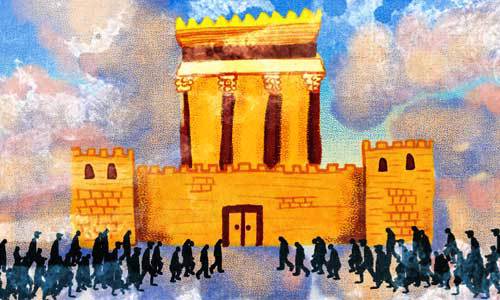
The book of Ezekiel culminates with a prophecy envisioned on Yom Kippur 3352 (410 BCE), fourteen years after the First Temple’s destruction. Ezekiel saw himself being transported to the Temple Mount, where an angel holding a measuring rod gave him a detailed tour of the Third Temple, delineating the exact measurements of its various structures.33
Read more: Four Unique Characteristics of the Third Temple
Ezekiel was instructed to impart this vision to his brethren, so that they would study the building’s dimensions and be prepared to build it when the time would come.34 In this way, the Jews heard a clear message: the Temple’s recent destruction was merely temporary, and an edifice even greater than the first would ultimately be erected.
The Midrash records a discussion between G‑d and Ezekiel:
Ezekiel said to G‑d: Master of the World! The Jews are exiled in the land of their enemies, and You are telling me to inform them of the Temple’s dimensions? Are they able to build it now? Wait until they are redeemed from exile, and then I will tell them!
G‑d responded: Just because My sons are in exile, My home should not be built? Tell them to study the form of the Temple, and it will be as if they are actually building it!35
In this spirit, it is customary to study the Temple’s dimensions, including these chapters of Ezekiel, during the Three Weeks of mourning (17 Tammuz–9 Av), utilizing these days to act toward the future rebuilding of the Temple.36
This section of the book of Ezekiel also contains detailed descriptions of how the Third Temple will be run. Some of his statements appear to be in conflict with the rules given in the Torah: sacrifices are described which have no parallel elsewhere as to number and amount; regulations are given for the kohanim (priests) which according to Torah law apply only to the kohen gadol (high priest); and so forth.
The Talmud records how at one point the sages felt that it would be necessary to “hide away” the book of Ezekiel to prevent misunderstandings, but that it was saved for posterity by the herculean efforts of Chananyah ben Chizkiyah, who used up “300 barrels of oil” for lighting as he analyzed the verses and deduced their true meanings.37
One approach is to read these verses in a less literal way, so as to yield the same laws as in the Torah albeit stated differently.38 Another is to say that the sacrifices described apply only during the dedication period of the Third Temple, much as there were unusual offerings brought during the dedication of the desert Tabernacle and of the First and Second Temples,39 and that the regulations for the kohanim are meant to place them on the higher level of the kohen gadol, appropriate to the greater level of sanctity that will prevail at that time.40
Ezekiel‘s Passing and Burial
Ezekiel passed away sometime before the year 3364 (397 BCE), and was buried in Babylonia.41 In 3364 Nebuchadnezzar died, and his son Evil-Merodach, who assumed the Chaldean throne, released the Jewish king Jehoiachin from prison.42 Jehoiachin, accompanied by a large entourage of Jews, visited Ezekiel’s gravesite and built a magnificent tomb upon the site, which also served as a synagogue.43
Rabbi Benjamin of Tudela, who visited the tomb in c. 4930 (1170), recounted that Jews would journey there from Baghdad every year to pray during the High Holidays, and on Yom Kippur they would read from a Torah scroll written by Ezekiel’s own hand.44
Ezekiel’s gravesite is believed to be in Al Kifl, Iraq, although this is not conclusive.
Read more: The Prophet Ezekiel

The Village Dweller
The Talmud points out45 that while Ezekiel described the Divine Chariot in great detail, the prophet Isaiah depicted G‑d’s glory in short, concise terms. It compares their perspectives to those of a city dweller and a village dweller who both saw the king. The city dweller doesn’t get excited by the fancy carriages, the uniforms and the royal display, because he sees these all the time. His focus is on the king himself. On the other hand, when a village dweller sees the entourage, since he rarely experiences such displays, every detail is exciting.
While this comparison seems to downplay Ezekiel’s prophecy, it actually conveys a profound message. The purpose of Creation is to recognize how everything in the material world is a reflection of what exists in the higher realms. This idea is expressed in Ezekiel’s vision, where the focus is on the details, from which G‑d’s greatness is perceived. From Ezekiel’s words we understand that his vision was a likeness of the higher realms, and this is an awareness we must strive to internalize.46

Read more: Seeing the Divine in the Physical

Join the Discussion