

As recorded in the Bible, Abraham (or Avraham, אברהם) the Hebrew was guided by G‑d to the Holy Land (then known as Canaan), which G‑d gave him as the everlasting inheritance of his children, the Jewish nation. Together with his wife, Sarah, he taught people about the existence of a G‑d who is one and cannot be seen. His legacy was carried on by his son, Isaac, whom he almost sacrificed at G‑d’s command. The first of the patriarchs, he is referred to by Jewish people as Avraham Avinu, “Abraham our Father.”
Abraham’s Early Life
The Bible is relatively silent on the first few decades of Abraham’s life, telling us that he was the son of Terach and husband of Sarah, but not much else. But many crucial details are filled in by the Midrash and Talmud. Here is how it is summed up by Maimonides:
After this mighty man [Abraham] was weaned, he began to explore and think . . . “How is it possible for the sphere to continue to revolve without having anyone controlling it? Who is causing it to revolve? Surely, it does not cause itself to revolve.”
He had no teacher, nor was there anyone to inform him. . . . He realized that there was one G‑d who controlled the sphere, that He created everything, and that there is no other G‑d among all the other entities. . . .
Abraham was 40 years old when he became aware of his Creator. When he recognized and knew Him, he began to formulate replies to the inhabitants of Ur Kasdim [where he lived] and debate with them, telling them that they were not following a proper path. He broke their idols and began to teach the people that it is fitting to serve only the G‑d of the world. . . .
When he overcame them through the strength of his arguments, the king [Nimrod] desired to kill him. He was [saved by] a miracle and left for Charan. [There,] he began to call in a loud voice to all people and inform them that there is one G‑d in the entire world and it is proper to serve Him.1
Read More: The Life and Times of Nimrod
Abraham in the Bible
Abraham takes center stage in the biblical book of Genesis, in the three portions of Lech Lecha, Vayera and Chayei Sarah (Genesis 12-25).
The story begins with a Divine call for Abraham to “go for yourself from your land, from your birthplace and the house of your father, to the land that I will show you.”2 This is accompanied by promises of great blessings.
But when Abraham, Sarah and nephew Lot arrive in the land that G‑d has shown him (Canaan), severe hunger forces them down to Egypt, where beautiful Sarah is abducted by King Pharaoh. After being punished by G‑d, Pharaoh realizes that he is dealing with holy people and sends them off with great riches.
Read More: Abductions in the Torah
In Canaan, Abraham’s shepherds quarrel with the Lot’s shepherds, and the two relatives agree to part ways, Lot traveling to the evil city of Sodom.
Even as Abraham and Sarah gain adherents to their way of life and prosper, they long for a child. Following Lot’s departure, G‑d promises Abraham that his descendants will one day be as numerous as the dust of the earth, and they will dwell in the land G‑d had brought him to.3
But this is not to happen yet. A war breaks out between nine kings, and the denizens of Sodom, along with Lot, are captured. Upon hearing of his relative’s distress, Abraham and his servant Eliezer come to the rescue of Lot and the other captives. After that victory, he is greeted by the mysterious Melchizedek, King of [Jeru]salem.4 Read More: Who Was Melchizedek?
The Covenant Between the Parts
Following those incidents, Abraham fears that he has perhaps “used up” his share of Divine favor. In a dramatic revelation known as the Covenant Between the Parts, G‑d appears to Abraham and promises him that he will have children who will inherit the promised land of Canaan. But first they will go down to a land where they will be enslaved.5 Read More: Abraham’s Covenant With G‑d
Hagar and Ishmael
In a selfless effort to facilitate G‑d’s blessing, Sarah offers her maid Hagar to Abraham, hoping that he will perhaps have a child with her. But this does not work out smoothly. Hagar is soon carrying a child, and she begins to torment her mistress. When Sarah puts her in her rightful place, Hagar flees. An angel finds her by a desert well and promises her that she will soon have a son, Ishmael, who will be “a wild donkey of a man.” Indeed, when Abraham is 86 years old, Ishmael is born.6
Circumcision and the Promise of a Child
When Abraham is 99 years old, G‑d commands him to undergo circumcision and to perform the procedure on all the males of his household, including the 13-year-old Ishmael.
G‑d then reiterates His promise of many children, along with an important instruction. Abraham, who has been known as Abram, will now have the Hebrew letter hei added to his name. And Sarai will henceforth be known as Sarah. The subtle differences are important. Abram means “father of Aram,” his place of birth, insinuating a localized sphere of influence. Sarai means “my princess,” but Sarah implies that she is the princess of all. This name change created a change in destiny, allowing them to become global figures whose spiritual and biological offspring would last for eternity. 7
Read More: Name Changes in the Torah
Three days later, as Abraham sits at the entrance of his tent, recuperating from his circumcision, three angels disguised as men appear before him. Abraham and Sarah overextend themselves to host them. Abraham slaughters a calf (or three, according to the Midrash), and Sarah bakes bread. As the men eat under the shade of a tree, they promise that Sarah will give birth within the year. Listening from within the tent, Sarah breaks out into laughter.
The Destruction of Sodom
The angels leave, but their mission is not complete. Two of them continue to Sodom, where they are charged with destroying the entire area (five cities in all), which has been rife with corruption, thievery and ill-treatment of wayfarers.
But first G‑d speaks to Abraham, telling him of His plans. Ever the “man of kindness,” Abraham pleads to G‑d, asking him to save the five cities in merit of 50 righteous men, but 50 men cannot be found. Abraham continues to bargain, but after even 10 righteous men can not be found, he concedes defeat.8
The angels save Lot and his daughters, but destroy the other evildoers of Sodom, including Lot’s own wife, who turns into a pillar of salt.9 Read More: Sodom and Gomorra: Cities Destroyed by G‑d
Sarah’s Second Abduction and the Birth of Isaac

In an incident eerily similar to what happened so many decades prior, Abraham and Sarah relocate to Gerar. Again fearing that the local monarch will take his wife and kill him, Abraham pretends that Sarah is his sister. King Abimelech of Gerar takes Sarah for himself, but before he can touch her, G‑d strikes Abimelech and his household with a mysterious malady that affects their orifices. G‑d then appears to Abimelech in a dream and tells him to release Sarah since she is a married woman. Abimelech gives Abraham and Sarah many gifts, and Abraham prays for Abimelech’s recovery. 10
Sarah is then blessed with what she has been waiting for: she becomes pregnant!
Following G‑d’s word, the baby is circumcised on the eighth day of his life and is named Isaac. Read More: Why Wait 8 Days for Circumcision?
But all is not well in Abraham’s family. As Isaac grows up, Sarah becomes increasingly alarmed that unruly Ishmael will have a negative influence on her son, the future bearer of Abraham’s legacy. With G‑d’s approval, Abraham sends away Hagar and Ishmael, who settle in the desert.11 Read More: Ishmael: Abraham’s Other Son
The Final Test: Abraham’s Sacrifice of Isaac
Throughout his life, Abraham suffers greatly. G‑d challenges him with no less than 10 tests (read: What Were Abraham’s 10 Tests?), culminating in the hardest one of all: G‑d tells Abraham to take his beloved son Isaac and sacrifice him “upon the mountain that I will show you,” Mount Moriah.
Stoically, Abraham rises early in the morning and takes his son Isaac (by then 37 years of age), a knife and fire, and journeys to the designated place.
Once there, Abraham binds Isaac to the altar he has built and extends his arm to sacrifice his son. Then, in the nick of time, an angel comes and tells Abraham to stop. G‑d just wanted to test his loyalty, and there is no need to go through with the sacrifice.
Lifting his eyes, Abraham sees a ram whose horns are trapped in the bushes. Abraham slaughters the ram and sacrifices it instead of his son.12
Read More: The Great Test: The Binding of Isaac
Sarah’s Passing and the Hebron Purchase

After living a full and rich life of 127 years, Sarah passes away in the city of Hebron. In the presence of the residents of the city (Hitites), Abraham asks if Ephron would sell him the burial Cave of Machpelah, which is in his field. Unbeknownst to Ephron, Adam and Eve were buried in this special cave (read how Abraham knew here).
Despite his grandiose offers to give the cave for free, Ephron sells the plot to Abraham for the princely sum of 400 silver coins, and Abraham buries his wife there.13
Isaac and Abraham Both Marry
Although Sarah does not live to see Isaac build a family, Abraham is determined to make it happen—in the best way possible. Rather than match up his son with one of the idolatrous women of Canaan, Abraham dispatches his servant Eliezer to his former home of Aram Naharaim to find a fitting bride for his son.
The Torah describes in great detail how Eliezer prays for Divine assistance and is guided to Rebecca, the great-niece of Abraham, who kindly offers water to the traveler and his caravan of thirsty camels (read how Eliezer knew she was “the one”).
“And Isaac brought her to the tent of Sarah his mother,” the verse tells us, “and he took Rebecca, and she became his wife, and he loved her. And Isaac was comforted for [the loss of] his mother.”14
With his son firmly ensconced in matrimony, Abraham gets remarried to a woman named Keturah, whom some identify as Hagar,15and has many more children. Read More: What Happened to Abraham’s Other Descendants?
At the ripe old age of 175, Abraham passes away and is buried by Isaac and Ishmael.16
Abraham = Love
The prophet Isaiah refers to him as “Abraham My lover.”17 Indeed, Abraham lived a life of love. He loved G‑d, loved people, and therefore endeavored to teach everyone about G‑d. In this light, it becomes all the more poignant that Abraham overcame his natural loving tendency and was prepared to sacrifice his beloved son upon an altar. This supreme sacrifice is a central theme of the Rosh Hashanah prayers, when we ask G‑d to override any harsh judgements He may have against us.
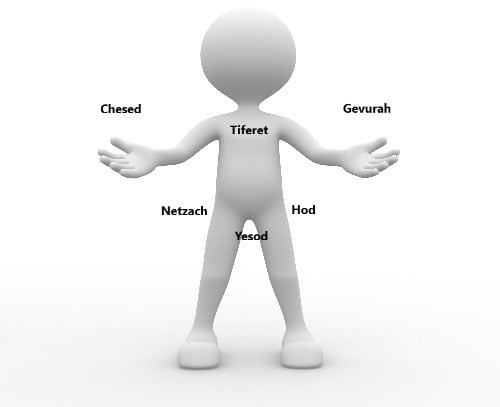
From a Kabbalistic perspective, Abraham is associated with the attributes of chessed (kindness) and ahavah (love), the first of the seven middot (emotive attributes). This is in contrast to Isaac, who personified gevurah (severity) and yirah (awe). The middot make up the “cosmic body”; chessed is on the upper right (arm), while gevurah is on the left.
Abraham the Host
Abraham and Sarah were famous for their hospitality. Their tent was open on all four sides, and travelers were welcome to refresh themselves before moving on. Besides for caring for their physical needs, Abraham would also tend to their spiritual state. As the Talmud puts it,
Abraham our forefather caused the name of G‑d to be called out in the mouth of all passersby. How so? After the guests of Abraham ate and drank, they would bless him, but he would say to them: Did you eat from what is mine? The food you ate belongs to the G‑d of the Universe, so thank and praise and bless the One Who spoke and brought the world into existence.”18
Where Was Abraham?
Above, we shared a synopsis of Abraham’s early years, how he bravely stood up to the powerful Nimrod and proclaimed G‑d’s unity to all. Why is the Torah silent on this aspect of his life, only starting with G‑d’s instruction to Abraham to relocate to the Promised Land?
This story was recorded in the Torah not so much for us to learn about Abraham's personal life, but more significantly to learn about our own. As long as G‑d had not communicated to Abraham, the story was captivating and inspiring, but it was unique to Abraham, a string of accomplishments that could not have possibly been expected from the average Jew.
However, the life of Abraham after G‑d’s revelation is based on G‑d’s command, something that applies equally to each and every member of the chosen people. As grandchildren of Abraham, we are all empowered to follow G‑d wherever he may lead us.
Read More: Jew: Noun or Verb?
Join the Discussion